Showing posts with label Holidays That Should Be Celebrated With Eggnog. Show all posts

Thursday, January 23, 2014

Quando Umni Flunkus Moreggnogi

Those unfamiliar with public television in the United States probably have never heard of the Red Green Show.  That's a true tragedy, as the show had unparalleled success with a fifteen-year run, and in our opinion, should still be running today.  (The success could not be paralleled because the show's trajectory was more of a random walk than a straight line...)

The Red Green Show has everything one could ask for in a sketch comedy masterpiece: a possum-themed van, a duct tape fixation, Canadians, a possum-themed lodge complete with latin motto, multi-colored suspenders, loads of old-timey wisdom, a possum-themed club, creative repurposing (what we call whatchagotamology), and bad puns.  If you're not familiar, you definitely owe it to yourself to check out a few episodes, which are readily available thanks to the magic of the internets.

Anyway, the Red Green Show debuted in January, 1991, which means that this month is the 23rd anniversary of arguably the best TV show ever.  This is the type of event that we celebrate with eggnog.  We had originally planned to make a possum-themed eggnog, but Katie vetoed that before we even had time to catch a possum.  So instead, here is a red- and green-colored eggnog.

Start with some type of red berry leftover from the holiday season.  For us, that was cranberries, but this 'nog would also work great with cherries, raspberries, strawberries, pomegranites, or all of the above!  For the cranberries, we had about 1.25 cups, which we added to a pot with 0.33 cups water, and cooked until the berries were mashable.  We started cooking them in the microwave, but they sounded like they were going to explode after a few seconds, so we switched to the stove (by Katie decree).  Also, if we had more cranberries, we would have probably doubled this amount.  The red color and cranberry flavor could have been stronger.

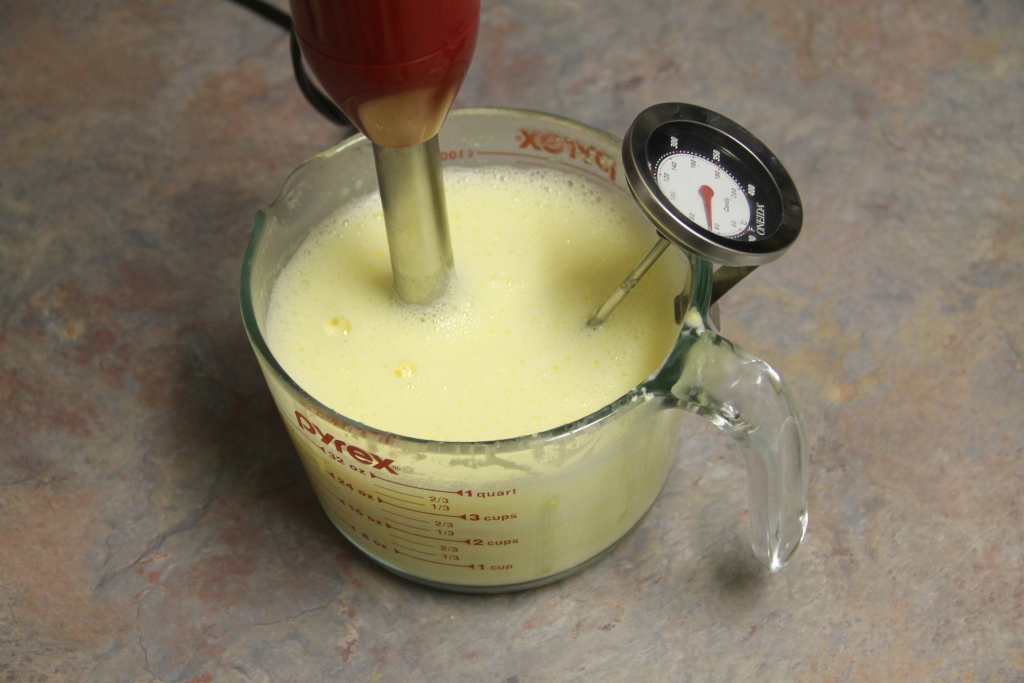
While the cranberries were cooking, we started same as always: beat six egg yolks until thick and bright yellow, mix in 1.5 cups milk, and microwave until the temp reaches 160 °F.


Then we mixed in 1 cup sugar and another 1.5 cups milk, then the mashed cranberries.  That's more sugar than usual, but the cranberries turned out to be pretty tart.

We had trouble breaking up the cranberries fine enough with just the egg beater (we keep forgetting to sharpen the beater blades!), and our stick blender is on the fritz, so we had to resort to Big Bertha for the homogenization.  If possible, add all the berries and just enough eggnog to make it blend right.  If you add all six cups at once, the cranberries take longer to blend, and you might have to clean up the kitchen before your next picture.

On second thought, that nog doesn't look quite red enough.  Let's add some sour cherry jam!

There...that's a little rosier!  Maybe we could have also used up some leftover red sprinkles to make it even more red.  Or we could have added other red-colored spices to help fend off the cold January weather. 

Now for the green part: leftover sprinkles from decorating Christmas cookies! (Since we're fresh out of mint and kiwis, and garnishing with parsley didn't seem quite right...)  And there it is: Red Green-themed eggnog.  Feel free to adjust or embellish this recipe as you see fit.  After watching a few episodes of the Red Green show, you'll definitely have some ideas for how to make it better.  Remember: if the women don't find you handsome, they should at least find you handy.


The recipe:
6 egg yolks
3 cups milk, divided into two batches of 1.5 cups
1 cup sugar
1.25 cups cranberries or other red fruit
0.33 cups water
0.33 cups cherry jelly (or jelly from other red fruit)
Green sprinkles to taste

Beat egg yolks until thick and yellow, then mix in 1.5 cups milk.  Heat until 160 °F, mix in sugar and then the remaining milk, cranberries, and cherry jelly.  Blend until homogeneous and red-colored.  Cool to room temp (or colder), pour into glasses, and garnish with green sprinkles.


How do you color your eggnog red?  Is the Red Green Show also your favorite PBS show?  Let us know in the comments section below!


Thursday, December 12, 2013

Missile Nog

It's interesting to us how many of our Christmas traditions center around the simple task of decorating the Christmas tree.  Listening to the Grinch song on repeat until Katie can't stand it and turns on Trans-Siberian Orchestra, Jake hanging the hideous homemade ornaments from his childhood front and center on the Christmas tree (one is a matte gray-painted styrofoam ball with colorful snowflake-shaped sequins sporadically glued to it, affectionately named the 'Death Star'), Katie discreetly moving those same ornaments to the lower back portion of the tree before visitors stop by, and, of course, drinking eggnog.  For an occasion such as this, there must be eggnog!

"What should we do to make this eggnog unique?" Jake asked Katie

"There's no need to--it's December and people are already drinking regular eggnog for Christmas," said Katie

"But, but..." Jake protested

"Just make some regular old eggnog so we can decorate the tree!" Katie interjected.

So here we present, somewhat dejectedly, a standard recipe for making normal eggnog.  But wait!  What if it's served under mistletoe?  Then it could be missile nog!  Ok, that works.  To give full credit, everything but the pasteurization step comes straight from sister-in-law Julia.  Thanks, Julia!

Start with 3 cups a milking and 12 eggs-a-yolking.  Beat the egg yolks until thick and light yellow, then mix in the milk.
Heat to 160 °F to kill any salmonella-a-lurking.
Mix in one cup-a-sugaring and another 3 cups-a-milking.  Cool to one room-a-temperaturing.
Pour into eight cups-a-waiting and garnish with two pinches-a-nutmegging and two pinches-a-cinnamoning.
Make sure Katie has to go under the mistletoe to get hers.  Then surprise her like a heat-seeking missile with a smooch! (And you thought missile nog was a stretch...)
Make sure to enjoy at least one glass each while decorating a Christmas tree.  Or a Hanukkah bush.  Or a Kwanzaa shrub.  Or whatever you're into.

The recipe:
12 egg yolks
6 cups milk, divided into two batches of three cups
1 cup sugar
2 pinches nutmeg per glass
2 pinches cinnamon per glass

Beat egg yolks until thick and yellow, then mix in 3 cups milk.  Heat until 160 °F, mix in sugar and then remaining milk.  Cool to room temp (or colder), pour into glasses, and garnish with nutmeg and cinnamon.


What are your tree-decorating traditions?  How many of them involve eggnog?  Let us know in the comments section below!


Thursday, November 7, 2013

Maple BCA Nog

Let's say that, hypothetically, even though you just celebrated National Pumpkin Cheesecake Day and National Mole Day a couple weeks ago, your chickens are in overdrive for some reason and gifting you with more eggs than you can reasonably use.  More than you can reasonably use, that is, until you realize that November 7 is National Bittersweet Chocolate and Almond Day and that November is Native American Heritage Month.  What is one traditional sweetener of many Native American tribes?  Maple syrup, of course!  (Buddy the Elf loves celebrating Native American heritage.)  Fun fact: if the water in maple sap is evaporated under vacuum at low temperature instead of boiled, nearly pure sucrose syrup is the product.  The heat from boiling the sap results in some dehydration and Maillard reactions of the sucrose molecules (and the less-concentrated glucose, fructose, and impurities), which give the characteristic maple flavor and color.

When we first considered the amalgamation of chocolate, maple, and almond, we were somewhat skeptical that such bold flavors could be favorably combined, but we were encouraged by rave reviews of other similarly-seasoned dishes.  Fortunately, our courageousness paid off.  However, we wish we had a more clever name for this flavor of eggnog, but we couldn't come up with anything good.  If you have a better idea, let us know!

As usual, start with six egg yolks and beat until thick and light yellow.  Trick question: can you find the sixth yolk in the shot on the left?
Mix in 1.5 c milk and heat to 160 °F to pasteurize.
Mix in 1 c. bittersweet chocolate chips, melted down to about 0.5 cups, then 0.5 cups maple syrup, 1-2 teaspoons almond extract, and 1.5 cups milk, in that order.  The reason is that the chocolate and syrup disperse in the nog much better when it's still warm, and the milk cools it down a lot. In reality, one could also use cocoa powder, milk chocolate, semisweet chocolate, or melted Halloween candy and achieve similar results, but bittersweet chocolate is recommended for the spirit of the day.
Enjoy the nog while admiring silly edible artwork.  As an aside, making this recipe is a good way to drown your sorrows when your favorite football team plays poorly, especially on a Monday night when the star quarterback gets injured.
The Recipe:
6 egg yolks
3 c. milk
1 c. bittersweet chocolate chips, melted
0.5 c. maple syrup
1-2 t. almond extract

Beat the egg yolks until thick and yellow, add half the milk, mix well, and heat to 160 °F.  Add melted chocolate, then syrup, then almond extract and remaining milk, mix well.  Cool to room temperature or below if will power permits.


Have you thought of a better name for this flavor of eggnog yet?  How do you celebrate Native American Heritage month? (Other than with a glass of eggnog, of course.)  Let us know in the comments section below!


Thursday, October 31, 2013

Holy Moley Pumpkin Nog

In the interest of full disclosure, we admit that we kind of dropped the ball on our October eggnog recipe.  We meant to celebrate National Pumpkin Cheesecake day with a pumpkin-flavored eggnog.  But we were too busy putting together our row cover chicken tractor, and we forgot all about it.  So, to make up for it, we wanted to belatedly celebrate another October holiday, and one that is observed mainly by dedicated chemistry nerds (including us): National Mole Day.  National Mole Day is October 23 (after the 1023 part of Avogadro's number, 6.02 x 10²³, the number of items in one mole of something.  (Just like a dozen means twelve of something.  If you want to know where the number comes from, look here.)  National Pumpkin Cheesecake day is October 21, for no good reason that we can see, other than being in the prime of pumpkin season.  But celebrating two October holidays belatedly equals celebrating one October holiday on time, right?  Anyway, here's how we prepared pumpkin cheesecake-themed eggnog, with the recipe given in terms of moles. (Translation follows below.)

Start with the yolks from 9.96 x 10⁻²⁴ moles of eggs and beat them until thick and light yellow.  Mix in 18.9 moles of milk (assuming that an average molar mass of milk is around 19 g and has a density of around 1.01 g/mL), and heat to 160 °F.

Add 1.18 x 10⁻²⁵ moles of brown sugar crystals (assuming a crystal size of 1 mm x 1mm x 1mm and a packing fraction of 0.6), 1.66 x 10⁻²⁴ moles of cream cheese (since one foil-wrapped 8-oz package is definitely the SI standard unit of measure for cream cheese), 2.24 x 10⁻²² moles of pumpkin as puree (assuming an average pumpkin diameter of 20 cm and pumpkin core diameter of 10 cm, with the core containing seeds and other stuff) another 18.9 moles of milk, 1.25 x 10⁻²⁴ moles each of ground cinnamon and ginger (assuming a particle size of 0.1 mm x 0.1 mm x 0.1 mm and a packing fraction of 0.6), and 2.49 x 10⁻²⁴ moles each of ground allspice and cloves (same assumptions).  Mix in the cream cheese and sugar first so they melt/dissolve nicely, then pumpkin, then milk and spices.

Mix it all together well with the eggbeater.

Wait until cool if possible, and pour into glasses.  (We couldn't wait until it cooled all the way to room temperature).  Serves 0.996 - 1.33 x 10⁻²³ moles of people.  If you expand this up to the one-mole scale, let us know.  Actually, we might be able to tell anyway, because that would probably require every egg in the entire world, and deadly eggnog floods would claim the unsuspecting and those who could not escape up the giant mountain of eggshells left behind.  Although, if one had to choose a way to go...


The Recipe:
9.96 x 10⁻²⁴ moles of egg yolks (6)
37.7 moles of milk (3 c.)
1.18 x 10⁻²⁵ moles of brown sugar crystals (0.5 c.)
1.66 x 10⁻²⁴ moles of cream cheese (8 oz.)
2.24 x 10⁻²² moles of pumpkin as puree (0.5 c.)
1.25 x 10⁻²⁴ moles of ground cinnamon (0.25 t.)
1.25 x 10⁻²⁴ moles of ground ginger (0.25 t.)
2.49 x 10⁻²⁴ moles of ground allspice  (0.5 t.)
2.49 x 10⁻²⁴ moles of ground cloves  (0.5 t.)

Beat the egg yolks until thick and yellow, add half the milk, mix well, and heat to 160 °F.  Add cream cheese and sugar, mix well, then add pumpkin, spices, and the rest of the milk.  Pour into 6-8 glasses and serve while telling corny chemistry jokes.  Best enjoyed between 6:02 pm and 6:02 am.


How did you celebrate national pumpkin cheesecake day and national mole day?  Do you think it would be totally awesome to swim in a river of pumpkin-flavored eggnog?  Let us know in the comments section below!
 

Thursday, September 19, 2013

Egg Grog

NOTE: This entire post must be read with gruff, vaguely old-English pronunciation.

Ahoy, ye scallywags!  If ye been payin' yer dues 'n readin' our tales o' gold-bellied egg drinks strong enough to rot yer chompers, ye know that we hafta set a holiday in this, the first fall month o' September, to honor with a new flavor o' eggnog.  And ye may have also noticed that today be the perfect day fer it, what with it bein' International Talk Like A Pirate day 'n all.  Now every good pirate knows that the best bit about bein' a pirate isn't the lootin' or the cutlasses, but is instead Ham Nite.  Ye may have noticed in the clips that afore the cap'n settled on Ham Nite, grog was in the runnin' to be the best bit o' the pirate life.

A normal grog is mix o' hot water, citrus juice (to keep the scurvy away), cinnamon, and honey.  And o' course, lots o' rum.  What the recipes above be missin', though, is the egg.  With the recipe below, ye can be sure that the best bit o' bein' a pirate would o' been the egg grog.  Should ye see fit, ye can follow the treasure map below to find some egg grog right in yer own kitchen.

Ye best start as afore, with six cackle-fruits, separatin' the yolks from their shells and whites, beatin' 'em like a bilge rat 'til they be thick and light gold, and mixin' in a pint and a half o' milk, or thereabouts.  If ye be from the Royal Navy, heat it up to 160 °F to kill any salmonella that might be lurkin' in yer eggs.  Real pirates with no fear o' Davy Jones' locker skip to the next step.
Add in a few pinches o' cinnamon, a quarter pint o' honey, an eighth pint o' frozen pineapple juice concentrate, and as much rum as ye see fit.  The exact measurements aren't important, lads--we're makin' a pirate brew here.  Mix it all together as if it were a giant whirlpool ready to swallow a ship whole.
When ye add the pineapple and rum, there's a good chance that some o' the milk and egg will take to separatin' from the mixture.  Should that occur, pull out yer electric trident and blend it back together.  Some scurvy landlubbers have come to call their electric tridents 'stick blenders,' but named them The Kraken for the purposes o' this post.
When yer grog has an acceptable disposition, pour it into yer steins and throw some shredded coconut on the top.  Ye can think of it as white seaweed or calamari if ye like.  'Tis a grand booty.
The Recipe:
6 cackle-fruits, just the yolks
1.5 pints (3 c.) milk
0.5 teaspoons cinnamon
0.25 pints (0.5 c.) honey
0.125 pints (0.25 c.) pineapple juice concentrate
Rum!
Shredded coconut

Beat the yolks 'til they be thick and bright gold, then mix in the milk.  Heat to 160 °F if ye see fit.  Mix in honey, cinnamon, pineapple juice concentrate and rum.  Beat until it's frothy as flotsam.  Top with coconut and take a hearty swig, mates!  Shiver me timbers, that's good!


Be ye ready to take to a life at sea for the egg grog alone?  What be yer favorite pirate brew?  Don't swing the lead, mates--let us know in the comments section asunder!


Thursday, August 29, 2013

Nog Brûlée

One faithful and astute reader recently pointed out to us that August was rapidly running out of days to celebrate, and we had yet to designate which of those days should be celebrated with eggnog.  Well, fear not, digital friends, because tomorrow is National Marshmallow Toasting Day!  We're going to celebrate this holiday by combining the two best parts of summer: s'mores and eggnog.  "But eggnog isn't normally even a part of summer!" you defiantly protest.  Well, just wait until next summer when this dish is on the front page of the New York Times, or some other famous publication.  This recipe is bound to go viral.  Maybe.

First, we should introduce the newest member of our family: Ed the Eggbeater.  When the plastic teeth on our old one finally did more slipping than biting, we decided to upgrade to one that was made probably 50 years ago.  (They just don't make them like they used to!  Darn kids, rastess frastess gobbeldy gook...).  Ed's got stainless steel gears, a near-zero-clearance connector piece at the bottom, and an ergonomically correct handle, like he's from the future.  So, if you ever happen to find yourself antique shopping with your mother-in-law on a beautiful gardening day, keep an eye out for one of these guys, and it will be a nice silver lining.  We just might have to have another go at egg-beater butter making, now that we've got Ed.  Thanks, Shari!
The recipe starts out like it always does here: separate the yolks from six eggs and beat them with Ed (or your analogous tool) until they're thick and yellow.  Then add 1.5 cups milk and heat 'em up until they hit 160 °F to kill all the salmonella.
Then add 0.25 cups brown sugar (or whatever type of sugar you prefer) and 10 quartered marshmallows.  Better taste-test a few marshmallows just to make sure you didn't happen upon a pile of Michelin Man turds.  Mix these in to the hot egg mixture with Ed.
When they're all dissolved, add another 1.5 cups milk and cool down.  Actually, we didn't cool it down this time, and the finished product was surprisingly drinkable warm.  Still, we think it would probably be better cold.  When it gets to your desired temperature, pour it into your fancy drinking glasses.
Now comes the fun part.  We're celebrating National Marshmallow Toasting Day.  If you were paying attention, we didn't toast the first ten marshmallows we added.  We just dissolved them with the mighty beater-like arms of Ed.  The 11th marshmallow is the lucky one.  (Or unlucky, depending on your perspective.)  Take marshmallow number 11 and soak it in the most concentrated liquor you've got for a few minutes.  It will help to swish it around in there and squeeze it like a sponge to expel the air and fill the pores with alcohol.  In case you were wondering, 190 proof (95 volume percent) is as concentrated as ethanol can get by distillation because it forms an azeotrope with water.  It results from non-ideal mixing of ethanol-water solutions. (To a certain extent, water would rather stick to water and ethanol to ethanol than water to ethanol or ethanol to water--it's a positive azeotrope!)  Ahh, thermodynamics.  If you want more concentrated ethanol, you can use 3A zeolites to remove the rest of the water, since water can enter the pores of the zeolites and form energetically favorable interactions with the pore walls, whereas the ethanol molecule is too large to fit in the pores.  Ahh, more thermodynamics.
Then add the alcohol-soaked marshmallow to the glass of eggnog, add another tablespoon of liquor, and light the sucker on fire.  Ethanol burns with a bluish flame, indicating that very little soot (carbon) is produced.  Ha ha, look at it go!
After a few minutes, it should get hot enough to start toasting the marshmallow.  We did some (extensive) experimentation with this part, and found that we couldn't get the marshmallow to toast reliably with (the less-concentrated) rum, or without adding an extra tablespoon of concentrated alcohol.  Alternatively, you could just add the alcohol and light it, then toast the marshmallow over your flambé-ing eggnog.
You might have to swish the marshmallow around in the glass a little to get it to toast (somewhat) evenly, and you might also have to blow out the flame before the marshmallow melts down into the eggnog.  Careful--you look better with fingers and eyebrows!  There will be some residual alcohol, which you will probably be able to taste. 
Once the fire is out, add a couple sections of graham crackers and some chocolate syrup that Katie made.  S'mores and eggnog--what could be better?  This is probably the start of a National Marshmallow Toasting Day tradition here at the Homestead Laboratory.  Let us know if you want to come celebrate with us--we'll make sure to have enough marshmallows for everyone!

The recipe:
6 egg yolks
1.5 cups milk
another 1.5 cups milk
1/4 cup sugar
10 marshmallows, quartered
Another marshmallow per glass, soaked in concentrated alcohol
1 tablespoon concentrated alcohol
1 tablespoon chocolate syrup and at least two graham cracker sections per cup

Beat egg yolks and 1.5 cups milk until uniform.  Heat mixture to 160 °F, stirring often.  Add sugar and quartered marshmallows, stir until dissolved.  Chill (or don't) and pour into glasses worthy of National Marshmallow Toasting Day.  Soak extra marshmallow in concentrated alcohol, add to glasses.  Add another tablespoon of concentrated alcohol to glasses, light on fire.  Swish marshmallow around to toast evenly.  Blow out fire before marshmallow melts.  Add graham crackers, garnish with chocolate syrup. 

How are you celebrating National Marshmallow Toasting Day (other than with eggnog)?  Do you know of any other ways to flambé eggnog?  Let us know in the comments section below!

Thursday, July 4, 2013

Independence Nog

Picture this: you return home from a long summer road trip, the weather outside is so hot that your shoes are sticking to the pavement (but at least the dew point is only 82 °F!), and your car's air conditioner puttered out 50 miles from home.  You're now sweating buckets, and you can't wait to get into your humble but cool abode, which you left at a comfortable yet energy-conscious 75 °F.  Now imagine that you swing open your front door only to be greeted by a blast of warm, steamy air even hotter than the outside...your house's air conditioner also puttered out, and your roof has been acting like a solar collector oven since early this morning.  You flop down into your thankfully-not-leather couch and wonder, "how can I possibly find some relief from this heat?" 

Obviously, your next move should be to fire up your computer and log on to The Homestead Laboratory to see if those guys have any ideas.  Imagine your delight when you find out that they have the perfect concoction to liberate you from your heat-induced misery while simultaneously celebrating the liberation of the good ol' USA from those silly-hat-wearing redcoats!  (...and also freedom from only being allowed to drink eggnog on Christmas and Easter.)  That's right!  We like to celebrate independence of all kinds with a tall (chilled) glass of eggnog, or in this case, independence nog.

The recipe starts out just like before--separate out six egg yolks and beat them until they're thick and light yellow.  Add 1.5 c milk and heat them up to 160 °F to kill any salmonella that might be lurking, then add 0.25-0.5 c sugar depending on your inclinations, and another 1.5 c milk.  This is where it gets interesting:

Where we're from, independence is celebrated with red, white, and blue.  We've got some red and blue berries, so we'll add those.  Also, you can see that we went a little overboard with our pasteurization again and a few pieces of the egg set up like a firm  custard.  Don't worry--the stick blender will take care of that!
After blenderizing everything with the stick blender, the red, blue, and yellow became this lovely purple color.  That's ok.  We'll add more red and blue later.
But first let's add some white!  Vanilla ice cream!  Yeah!  (It floats, therefore we conclude that ice cream is less dense than eggnog bubbles.)
There we go...red, white, and blue.  With a purple background. We, um...needed the purple to make the white stand out.  (Right?)  The nice thing is, if the berries are cold, they help cool down the eggnog so it's drinkable right away.  Good stuff, Maynard!


The recipe:
6 egg yolks
1.5 cups milk
another 1.5 cups milk
1/3 cup sugar
1/2 cup each red and blue berries (e.g., strawberries and blueberries)
another few berries for garnish
1 scoop per cup vanilla ice cream

Beat egg yolks and 1.5 cups milk until uniform.  Heat mixture to 160 °F, stirring often.  Add sugar and stir until dissolved, then add rest of milk and 1/2 cup each fruit.  Homogenize with stick blender.  Chill, garnish with vanilla ice cream and more berries, and drink.  Appreciate sovereignity.

What do you drink on the 4th of July?  What kinds of red and blue things would you add to your independence nog?  Tell us in the comments section below!

Thursday, June 20, 2013

Ants on a Nog

As you are no doubt aware, we are currently smack dab in the middle of Carpenter Ant Awareness Week, a week dedicated to educating folks about carpenter ants and the damage they can cause.  It always happens during the third week of June, and is typically 'celebrated' primarily by pest control companies as a kind of publicity event.  But we can get behind most things educational, and we can definitely get behind insect educational events.  So in the traditional sense, here's what you need to know about identifying, preventing, and controlling carpenter ants.  Please be responsible and read it.

We also wanted to do our part to spread the word in the nontraditional (i.e., more fun) sense, but Katie said she doesn't have enough time to make a giant ant costume on the sewing machine or make pamphlets to hand out to strangers on the sidewalk.  So, instead we decided to raise our glasses for a toast to carpenter ant education.  What's in our glasses?  Carpenter ant-themed eggnog. 

Start out as before, taking six egg yolks and beating them until thick and bright yellow, then mixing in 1.5 cups milk and heating to 160 °F.  While hot, add a third of a cup of sugar and mix to dissolve. We found out this time that if you heat the mix higher than 160 °F and the eggs start to set up, it's possible to make it uniform and not chunky again by hitting it hard with the stick blender.  The hand-crank egg beater would probably work, too, if it's functioning properly.
Add a couple tablespoons or so of peanut butter and mix well.  Then add the other 1.5 cups milk.
Add a half cup of finely chopped raisins, or add a half cup of raisins and finely chop them in situ with the stick blender, as long as it's already out.  Just like you would probably want to do to the carpenter ants, if they were busy eating your walls.
For the final touch, take a pinch of celery seed and grind it up with the ol' mortar and pestle.
The chopped raisins will probably sink to the bottom of the bowl, so make sure to stir well before serving.
Chill before serving, and garnish with a small hill of cinnamon and cloves.

Now, just like our earth 'nog may cause some readers to wrinkle their noses at the thought of chocolate eggnog, we realize that this recipe might raise a few eyebrows.  But, just like earth nog was the illegitimate offspring of a glass of chocolate milk and a bowl of custard, consider that this ant-themed recipe is sort of the goofy stepchild of your favorite preschool snack and a bowl of custard.  Katie has almost finished her entire glass already!  (Really!)

The recipe:
6 egg yolks
1.5 cups milk
another 1.5 cups milk
1/3 cup sugar
2-3 Tablespoons peanut butter
1/2 cup raisins, chopped
pinch ground celery seed
1 teaspoon ground cinnamon
1 teaspoon ground cloves

Beat egg yolks until thick and bright yellow, add 1.5 cups milk and mix until uniform.  Heat mixture to 160 °F, stirring often.  Add sugar and peanut butter, stir until uniform, then add rest of milk raisins, and celery seed.  Garnish with cinnamon and cloves.  Chill and drink. Explain to any guests that this is to raise awareness of carpenter ants and how to deal with them.

How are you celebrating carpenter ant awareness week?  How do you deal with carpenter ants?  Have you made this eggnog with real ants instead of raisins?  Let us know in the comments section below!


Thursday, May 30, 2013

Macaroonog

If you've been following our blog, you might have noticed we're kind of on a mission to spread the joy of eggnog, that delectable nectar, throughout the whole year.  We set about to find at least one holiday in every month that is worthy of celebrating with eggnog.  So far we've got Hog 'Nog, Green Eggs and Nog, and Earth Nog.  But the month of May is almost out, and we haven't yet designated an eggnog holiday!  Fortunately, May 31 (tomorrow!) is the perfect day to celebrate with eggnog because, as we're sure you know, it's National Macaroon Day!  Macaroons are commonly made with egg whites and coconut (says even the dictionary), but what happens to the leftover yolks?  We humbly suggest a macaroon-flavored eggnog.

Two common flavorings for macaroons (other than the sugar and eggs) are almond and coconut.  For our purposes, we wanted extracts, since we're making a liquid treat rather than a solid one.  We had almond extract on hand, but not coconut extract.  Also, real coconut extract is ridiculously expensive, so we decided to make our own.  It's not hard--pretty much as easy as making a cup of tea, except it needs to steep for several days.


We filled a half-pint canning jar about three-quarters full with shredded coconut, and then added rum up to the bottom of the threads.

We let it steep for about five days and then filtered out the large pieces of coconut.  There are still small coconut particles, which could be filtered out with a a piece of cloth or something, but we don't mind them.  It adds a little extra coconut flavor.  Also, the filtered coconut pieces are now soaked with rum, so they can be used to 'spice up' cakes, shrimp stir fries, or a breakfast bowl of oatmeal.

For the recipe, we followed the first part of our recipe for Earth Nog, where the big bowl in the middle is the six egg yolks and first 1.5 cups of milk heated to 160 °F, and the other ingredients (second 1.5 cups milk, 0.5 cup sugar, one tablespoon each coconut extract and almond extract), are about to be added to it.  Technically, the order of addition to the hot milk/egg yolk mixture should be sugar (which will dissolve faster at higher temperatures), then milk (which will cool the mixture down some), then the extracts (which would lose more potency from evaporation at high temperatures), but in practice, it probably doesn't make much difference.

We tried garnishing the 'nog with some of the filtered coconut, but it didn't stay on top very well.  Probably we should add a dollop of whipped cream, then garnish that with the coconut.

But we don't have any whipped cream made up, so we'll just add a strawberry and call it good. :-)  Definitely tastes like a macaroon (other than the strawberry).  Good stuff, Maynard!


The recipe:
6 egg yolks
1.5 cups milk
another 1.5 cups milk
1/2 cup sugar
1 tablespoon each coconut and almond extract

Beat egg yolks and 1.5 cups milk until uniform.  Heat mixture to 160 °F, stirring often.  Add sugar, then add rest of milk and extracts.  Garnish with whipped cream, coconut, and/or strawberries.  Chill and drink.


How are you celebrating National Macaroon Day?  Can you think of other uses for rum-soaked coconut, or other ways to garnish macaroon-flavored eggnog?  Let us know in the comments section below!

Monday, April 22, 2013

Earth Nog

For any of our loyal readers who might be getting nervous that April is almost over and we haven't designated a holiday this month to celebrate with eggnog, don't panic: Earth Day is today!  And boy, what a treat!  We've received a couple requests to prepare a pasteurized eggnog from some folks who definitely love their eggnog year round, but who aren't in love with year-round salmonella risk.  It's worth noting that the possibility an egg contains salmonella is small to begin with, but has very little to do with the style of agriculture that produced it.  The bacterium can come from many places, including the most natural of environments, although there is reason to believe that smaller flocks and less confinement can lead to lower salmonella counts.

As with everything on the Internets, there are differing opinions on what temperature is required to rid the eggs of salmonella.  The USDA and CDC say that 160 °F for any amount of time is a safe bet, but long times at lower temps will also work.  Since the egg can start to cook at temperatures as low as 140 °F, the pasteurization could potentially yield chunks in the eggnog. Some sources claim that adding an acid to the yolks can prevent them from getting chunky on heating, but their recommended process is somewhat involved since it's important to make sure that the temperature throughout the yolks stays fairly uniform.  However, the USDA also notes that if mixing some of the milk in the eggnog recipe with the egg yolks before heating might yield a good eggnog.  In this case, it's basically like making a custard that is then diluted with the rest of the milk.  That's the approach we'll try here for making our earth-flavored 'nog.

As before, start with six egg yolks and three cups of milk.  This time, however, only use 1.5 cups of milk at a time.

Mix together the yolks and 1.5 cups milk until homogeneous (bubbles are ok). EDIT: Make sure to beat the yolks first until stiff and pale yellow.  It seems to make the final product thicker and creamier.

Bring the temperature of the mixture up to 160 °F, either in a saucepan on the stove (slow) or in the microwave (much faster).  The trick is to make sure that the temperature rises fairly uniformly so that one part doesn't start to cook (denature) before other parts are pasteurized.  In the microwave (the way we did it), we started with two rounds of one minute, each followed by temperature checks and stirring, then a round of 30 seconds and stirring, then a round of 20 seconds and stirring.  We were skeptical that it would stay smooth to 160 °F, but sure enough it did!

Once it hits 160 °F, all the potential salmonella have been defeated and the rest of the ingredients can be added (1/3 cup sugar, 1/4 cup cocoa powder, 1 teaspoon vanilla extract, and 1.5 cups milk).  The order of addition isn't particularly important, but the sugar will dissolve faster in the high temperature egg-milk mixture than if the rest of the milk is added first (which will cool it down). 

Here we are: chocolate (earth-flavored) eggnog!  This recipe is actually much better chilled, unless you're into hot eggnog for some reason.  Don't tell Katie, but there's a gummy worm at the bottom of hers.  Also, before you wrinkle your nose at the thought of chocolate eggnog, consider that if a bowl of custard and a glass of chocolate milk got together one night, drank a little too much vanilla extract and made some bad choices, this is what the offspring would look like.  Maybe that analogy didn't help.  But really, it's good!

The recipe:
6 egg yolks
1.5 cups milk
another 1.5 cups milk
1/3 cup sugar
1/4 cup cocoa powder
1 teaspoon vanilla extract

Beat egg yolks and 1.5 cups milk until uniform.  Heat mixture to 160 °F, stirring often.  Add sugar and cocoa powder, stir until uniform, then add rest of milk and vanilla extract.  Chill and drink.

Have you made a cooked eggnog recipe before?  How did it turn out?  Tell us about it in the comments section below!